
Finding Your Ideal PEMF Therapy Session: A Practical, Research-Informed Guide
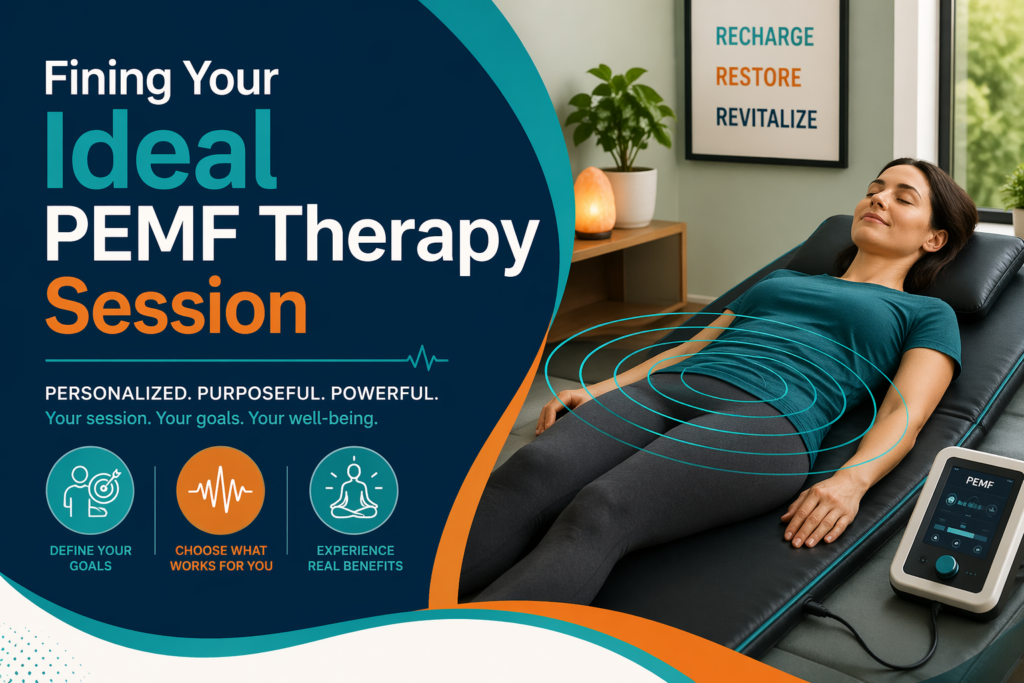
Pulsed Electromagnetic Field (PEMF) therapy is gaining traction as a powerful tool for recovery, inflammation reduction, sleep optimization, and overall cellular health. But one of the most common questions is also the most important: what is the “right” PEMF session to get maximum PEMF benefits? In this article, I will help you find your ideal PEMF therapy session.
The honest answer—supported by both expert practitioners and clinical research—is that there is no single universal setting. The ideal session depends on your goals, your body, and how deeply the therapy needs to penetrate. That said, clear patterns emerge when you combine expert insights with clinical trial data. This guide brings those together into a practical framework you can actually use.
The Core Principle: There Is No One-Size-Fits-All Protocol
Across both expert recommendations and clinical studies, one theme is consistent: PEMF therapy is highly individualized. The “best” settings depend on:
- The condition being addressed (pain, sleep, inflammation, recovery)
- The depth of the target tissue
- The device being used (home vs. clinical grade)
- Your personal sensitivity and response
Rather than chasing a single perfect setting, the goal is to understand ranges and then refine based on your experience.
Frequency: The “Control System” of PEMF
Frequency—measured in Hertz (Hz)—is often described as the most intuitive lever because it aligns closely with natural brainwave states.
A Simple Expert Framework
One widely used approach is to match frequency to time of day:
- Morning: 35–45 Hz (energy, mental clarity, reducing brain fog)
- Midday: 14 Hz (balanced focus)
- Afternoon: 8 Hz (calm productivity)
- Evening: 4–6 Hz (wind-down mode)
- Sleep: 1–2 Hz (deep relaxation and recovery)
For those who prefer simplicity:
- Daytime default: ~14 Hz
- Nighttime default: ~1 Hz
What Clinical Research Suggests
Clinical and mechanistic studies reinforce similar ranges:
- Sleep & recovery: 0.5–4 Hz
- Relaxation & stress: 4–8 Hz
- Pain & inflammation: 5–20 Hz
- Focus & energy: 8–30+ Hz
Lower frequencies consistently show benefits for sleep and inflammation, while low-to-mid frequencies are commonly used for pain and musculoskeletal support.
Intensity: More Isn’t Always Better
Intensity, measured in Gauss (or millitesla), determines how deeply the magnetic field penetrates tissue. PEMF intensity recommendations vary widely depending on who you ask. Some users and manufacturers feel that sub-1 gauss mats are more than sufficient, while other practitioners point to much higher intensities—sometimes around 50 gauss—as being more effective. I tend to take a middle-of-the-road approach. I recognize that even low-intensity systems like the Bemer-style mats can be helpful, but I also see value in moderate-intensity PEMF. A device around 10 gauss, for example, may have a greater ability to influence deeper tissues, which can potentially support recovery and repair more effectively for some users.
Expert Insight: The Functional Sweet Spot
- General effective range: 30–100 or more Gauss
- Optimal “sweet spot”: 10 -30 Gauss
- Minimum cellular activation: as low as 0.01 Gauss, but I recommend 2 Gauss minimum
However,if you treatind more serious medical conditions or trying to reach deeper into your body, I suggest buying the most powerful PEMF mat you can find.
Research adds an important nuance: the body absorbs only a fraction of the surface intensity.
- To achieve biological effects, about 15 Gauss at the tissue level is often needed.
- That means:
- Surface-level issues: lower intensity may suffice
- Deeper tissues (spine, joints): require significantly higher surface intensity
Clinical devices may use much higher outputs (even thousands of Gauss) for short, targeted treatments, while home devices typically stay in the 1–100 Gauss range.
Session Length: Where Experts and Research Converge
Time is one of the most consistent variables across both expert recommendations and clinical trials.
Common Ranges
- Standard sessions: 15–30 minutes
- Optimal single session: ~20 minutes (a common default in many devices)
- Extended sessions: longer durations or even overnight use at low intensity
Clinical Trial Patterns
- Pain studies: ~40 minutes per session, sometimes twice daily
- Inflammation (cell studies): 5–15 minutes
- Sleep protocols: 30–45 minutes or overnight
- Chronic conditions: daily use over weeks
One key takeaway: consistency matters more than session length alone.
Frequency of Use: Consistency Drives Results
PEMF therapy is generally considered safe for regular use, and benefits tend to accumulate over time.
- General wellness: 2–3 sessions per week
- Targeted goals (pain, recovery): daily or near-daily use
- Clinical-style protocols: multiple sessions per day for short periods
If you’re new, start conservatively:
- Short sessions
- Low intensity
- Gradual increases based on tolerance
Waveform: Why “Square Wave” Gets Attention
Among experienced practitioners, waveform is often overlooked—but important. Square wave forms are often favored for their rapid on/off transition (high “slew rate”), which may improve cellular energy transfer, while sine wave forms are commonly used in research and remain well-established, especially in inflammation studies. In practice, both are widely used, and the key is consistency and matching the device’s strengths. That said, experts do differ significantly on this topic. Some manufacturers—such as Bemer—promote proprietary waveforms they believe offer unique benefits, while others argue that square waves are superior due to their sharper transitions. At the same time, many clinical studies rely on standard sine waves and still report positive outcomes. From my perspective, many of the “special” or branded waveform claims are more marketing than science. The bottom line is that most waveforms appear to work to some degree, but if I had to choose, I would lean toward a square wave for its theoretical efficiency and simplicity.
- Square wave: favored for its rapid on/off transition (high “slew rate”), which may improve cellular energy transfer
- Sine wave: commonly used in research and still effective, especially in inflammation studies
In practice, both are widely used. I wouldn’t base a decision to buy a mat solely on the wave for its uses.
What Clinical Trials Actually Show
Clinical evidence doesn’t point to a single perfect protocol—but it does reveal patterns:
- Pain (including fibromyalgia):
- Low frequency
- Low intensity (~400 μT in some trials)
- ~40 minutes per session
- Twice daily for short periods (e.g., 7 days)
- Inflammation:
- Frequencies around 5–15 Hz
- Low to moderate intensity
- Short exposure times (5–15 minutes in lab settings)
- Sleep:
- 0.5–4 Hz
- Low intensity
- 30–45 minutes or overnight
- Daily use over weeks
The strongest takeaway: repeated exposure over time is more important than a single session.
A Practical Starting Protocol
If you want a simple, balanced place to begin:
Week 1–2 Starter Plan
- Time: 15–20 minutes
- Frequency:
- 5–10 Hz (relaxation/recovery)
- OR 10–15 Hz (general support)
- Intensity: Low to moderate
- Frequency of use: 3 times per week
Then gradually adjust:
- Increase session length toward 20–30 minutes
- Add sessions (up to daily use if needed)
- Fine-tune frequency based on how you feel
Advanced Optimization: Matching the Session to Your Goal
| Goal | Frequency | Intensity | Duration | Frequency of Use |
|---|---|---|---|---|
| Sleep | 0.5–4 Hz | Low | 20–45 min or overnight | Daily |
| Relaxation | 4–8 Hz | Low | 10–20 min | 2–7x/week |
| Pain relief | 10–20 Hz | Low–moderate | 20–40 min | 3–7x/week |
| Recovery | 5–15 Hz | Low–moderate | 15–30 min | Daily |
| Energy/focus | 20–40 Hz | Moderate | 10–20 min | As needed |
Safety Considerations
PEMF therapy is generally well tolerated, but there are important exceptions. Avoid or consult a clinician if you:
- Have a pacemaker or implanted electronic device
- Are pregnant
- Have had a recent organ transplant
- Have a serious or complex medical condition
Always defer to device-specific guidelines and professional advice when needed.
Final Thought: Your Body Is the Feedback System
The most important insight from both experts and research is this: your ideal PEMF session is discovered, not prescribed.
Start simple. Stay consistent. Pay attention to how your body responds.
For beginners, a simple starting point is 5–10 Hz for relaxation and general recovery, or around 10–15 Hz if your goal is pain relief or musculoskeletal support. These ranges are gentle and commonly well tolerated.
Most effective sessions last between 15 and 30 minutes. Many people start at 15–20 minutes and gradually increase to 20–30 minutes as their body adapts.
Yes, PEMF therapy is generally considered safe for daily use. Many protocols actually emphasize consistency, especially for sleep support, chronic pain, or recovery goals.
General effective range: 30–100 or more Gauss
Optimal “sweet spot”: 10 -30 Gauss
Minimum cellular activation: as low as 0.01 Gauss, but I recommend 2 Gauss minimum
If you ar treating more serious conditions or trying to affect tissues deeper in your body, I suggest getting a high-powered PEMF mat.
Over time, small adjustments in frequency, intensity, and duration can make a meaningful difference—turning PEMF from a generic wellness tool into a personalized recovery system. Click here for more PEMF buying tips or for a comparison of the top PEMF mats on the market today. I hope with this information you have the tools to find your ideal PEMF therapy session.

If you’ve been dealing with back pain, stress, poor sleep, or just feeling worn down, I know how frustrating it can be trying to find something that actually helps. That’s what led me to PEMF therapy in the first place. After experiencing the benefits firsthand, I wanted to help other people discover products that can bring real relief, relaxation, and a better quality of life without wasting money on overhyped products that don’t deliver.